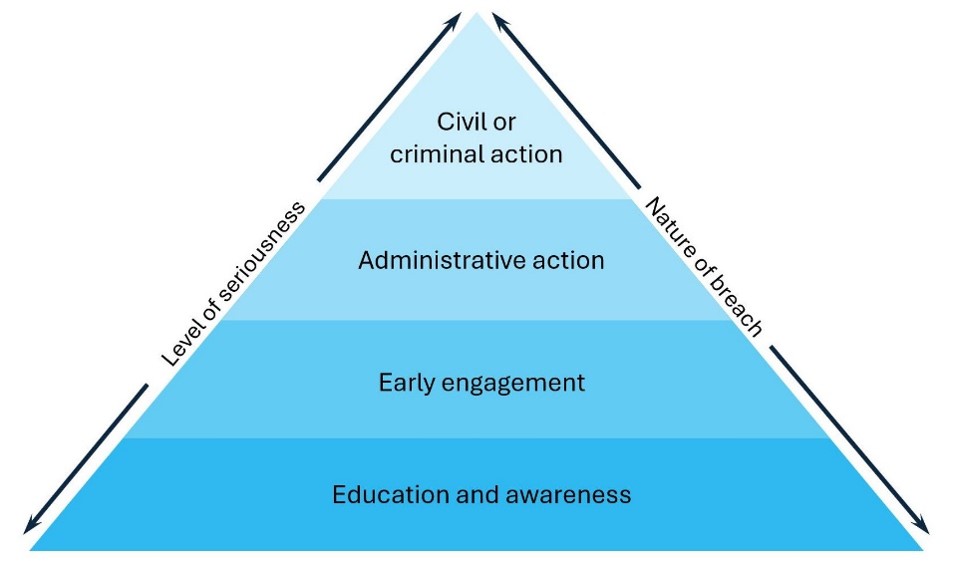
Compliance measures and practical actions
Tier 1 — Education and awareness
Education and awareness measures help prevent non-compliance and support voluntary compliance. Practical actions may include:
- resources and guidance on our website
- public information sessions and briefings
- direct support through email and phone contact
- pre-application meetings.
Tier 2 — Early engagement
Early engagement measures help identify and resolve potential compliance issues before formal action is needed. Practical actions may include:
- contacting us as soon as possible about a potential issue
- responding to requests for information or clarification
- taking timely corrective action where minor issues are identified
- maintaining records that show how the issue was addressed and how recurrence will be prevented.
At this tier, we may explain the legislative framework, decision-making process and possible regulatory outcomes. We cannot say in advance how a decision maker will consider a particular case or make their decision.
Tier 3 — Administrative action
Administrative action may be taken where informal action is not suitable or does not resolve the issue. Practical actions may include:
- applying, varying or enforcing title or licence conditions
- using information-gathering powers
- issuing statutory directions where the legislation allows
- recording the matter for consideration in future regulatory decisions.
Conditions
Conditions can apply to any title or licence. Your offer, grant or variation documents outline the conditions. They are statutory requirements. If you fail to comply with conditions, this may lead to compliance and enforcement action.
Decision makers assess each breach based on its unique circumstances. New title or licence conditions may be applied to address emerging risks.
Statutory directions
The responsible Commonwealth Minister, TA or the Registrar may issue statutory directions to title and licence holders in specific circumstances. These directions may relate to areas such as resource management, operational requirements or data submission and accuracy.
These directions are legally binding under the Offshore Petroleum Greenhouse Gas Storage Act 2006 and the Offshore Electricity Infrastructure Act 2021.
Cancellation
Decision makers assess breaches to decide how serious it is and if cancelling the title or licence is appropriate.
For example, exploration permits are granted through a work-bid system. The permit is granted based on the strength of the proposed work program (among other things). If the titleholder fails to meet the commitments in their work program, this may be considered a serious breach and could lead to title cancellation.
The final decision rests with the relevant decision maker.
Tier 4— Civil or criminal action
Civil or criminal action may be taken in response to serious breaches. It is not necessary to go through all other tiers before these actions are considered. The response depends on the nature and severity of the breach. Practical actions may include:
- pursuing a civil penalty through the courts
- commencing prosecution where appropriate
- considering cancellation or other regulatory measures where the legislation allows.
Civil penalty
The decision maker may pursue a civil penalty through the courts for breaches of the legislation or regulations.
Prosecution
The decision maker generally makes the initial decision to take legal action.